pay
You could also try:
Create a Job Worth Hierarchy
Blueprint: Total Rewards

Create a job worth hierarchy to illustrate where each job fits relative to every other job in the organization. This is critical to establish internal equity, provide legal defensibility, and verify market data.
Prove the value of job evaluation by implementing an effective and efficient process that is aligned with organizational strategy.
Develop a pay transparency strategy that suits your... Use the Pay Transparency and Communications Plan to:Document current and desired transparency states.Evaluate organizational factors to help you assess your organization's desired versus current pay transparency state.Create a pay transparency strategy to help you move from your current state.
Pay Transparency and Communications Plan
Tools And Templates: Total Rewards
Develop a pay transparency strategy that suits your organization and draft a communications plan that aligns to your strategic objectives.
Design a Purposeful Pay for Performance Program
Blueprint: Total Rewards
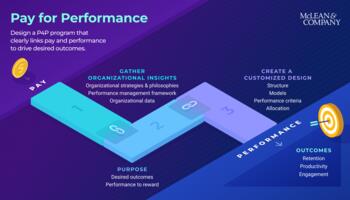
Use this research to build an intentional pay for performance program that meaningfully links organizational results to rewards and increases employee productivity, retention, motivation, and engagement.
Effectively link pay and performance to drive measurable organizational impact.
Use this research to build an intentional pay for performance program that meaningfully links organizational results to rewards and increases employee productivity, retention, motivation, and engagement. Effectively link pay and performance to drive measurable organizational impact.
Case Studies: Design a Purposeful Pay for Performance Program
Note: Total Rewards
Refer to these case studies for examples of purposefully designed pay for performance programs.
Pay for Performance Model Options Catalog
Note: Total Rewards
Use this catalog to explore and select pay for performance models.
Pay for Performance
Academy Course: Total Rewards
Examine how to align pay for performance with an organization’s context and people strategy, defining objectives for the approach and selecting appropriate methods to determine annual base pay increases and bonuses.
Design a Purposeful Pay for Performance Program Executive Briefing
Note: Total Rewards
Use this briefing to make the case for designing a pay for performance program to the executive team.
Pay for Performance Workbook
Tools And Templates: Total Rewards
Use this workbook to document key information about the program purpose, design, and launch.
DEI Lens: Design a Purposeful Pay for Performance Program
Note: Total Rewards
Use this download to review the diversity, equity, and inclusion considerations for pay for performance program design.
Guide to Creating a Pay for Performance Merit Matrix
Note: Total Rewards
Use this guide to understand key steps in creating a merit matrix.
Design a Base Pay Structure
Blueprint: Total Rewards

Compensation, specifically base pay, is usually the highest organizational cost, and a significant factor in employee attraction and retention. While few organizations lack any structure for base pay at all, many do not have a proper, equitable, consistent, and flexible approach.
Balance internal equity and market competitiveness to build an effective base pay structure.
Compensation, specifically base pay, is usually the highest organizational cost, and a significant factor in employee attraction and retention. While few organizations lack any structure for base pay at all, many do not have a proper, equitable, consistent, and flexible approach. Balance internal equity and market competitiveness to build an.
Case Studies: Base Pay Structure
Case Study: Total Rewards
A defined approach to base pay is essential to boost employee engagement and increase employee attraction and retention. Read these case studies to learn how these companies created a base pay structure that is defensible, competitive, flexible, and practical.
Base Pay Structure Tool
Tools And Templates: Total Rewards
Create a base pay structure that is internally and externally equitable by balancing the internal job worth hierarchy with external market competitiveness.
Design a Base Pay Structure Executive Briefing
Note: Total Rewards
Use this briefing to make the case to your executive team for designing a defensible, competitive, flexible, and practical base pay structure.
Salary Administration Guidelines
Tools And Templates: Total Rewards
Use this template to establish salary controls in order to avoid salary pain in the future.
Payroll
SoftwareReviews: Software Category
Payroll software is used to administer employee pay by calculating earnings, overtime, deductions, and taxes. The system maintains historical payroll records, processes recurring pay runs, and produces consistent documentation such as payslips, summaries, and compliance reports for operational reference and review.
Payroll software is used to administer employee pay by calculating earnings, overtime, deductions, and taxes. The system maintains historical payroll records, processes recurring pay runs, and produces consistent documentation such as payslips, summaries, and compliance reports for operational reference and review.
Conduct a Salary Assessment
Blueprint: Total Rewards

Salary structure assessments help prevent and address pay inequities. Download our research to learn the critical elements of a successful salary assessment.
Prevent and address inequities before they transform into bigger problems.
Refer to these case studies for examples of the benefits of performing a salary structure assessment. The following case studies provide examples of how to ensure salaries are administered accurately with internal and external equity on top of mind. Establishing a salary structure was an organization-wide effort at Chemtrade Community Living.
Case Studies: Conduct a Salary Structure Assessment
Case Study: Total Rewards
Refer to these case studies for examples of how organizations have undergone a salary assessment.
Salary Assessment Tool
Tools And Templates: Total Rewards
Use this tool to conduct a salary assessment at your organization.
Craft a Compensation Philosophy
Blueprint: Total Rewards
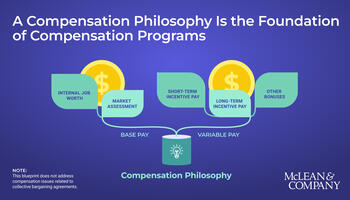
A clear compensation philosophy supports strategic decisions that optimize compensation costs while enabling organizations to effectively compete for talent in a competitive labor market.
Lay the groundwork for compensation that is competitive, cost effective, and brand aligned.
Use this Compensation Philosophy Template (also known as a Pay Philosophy) to document your organization’s governing principles for compensati... Use this Compensation Philosophy Template (also known as a Pay Philosophy) to document your organization’s governing principles for compensation programs and activities.Recommended categories.
Compensation Philosophy Template
Tools And Templates: Total Rewards
Use this Compensation Philosophy Template (also known as a Pay Philosophy) to document your organization’s governing principles for compensation programs and activities.
Equip Managers to Conduct Effective Pay Conversations
Blueprint: Learning & Development

Compensation often causes unnecessary stress and confusion between employees and managers. Support managers by providing the understanding, information, and guidance needed to hold successful compensation conversations with their employees.
Prepare managers to engage in difficult conversations about compensation.
Use this participant handbook as a resource for participants to reference during and after the Equip Managers to Conduct Effective Pay Conversations training.. This handbook serves as a reference guide participants will use to support formal training. The Equip Managers to Have Effective Pay Conversations Handbook includes: Key concepts and.
Handbook: Equip Managers to Conduct Effective Pay Conversations
Tools And Templates: Learning & Development
Use this participant handbook as a resource for participants to reference during and after the Equip Managers to Conduct Effective Pay Conversations training.
The Rise of Organizational Transparency
Blueprint: Culture
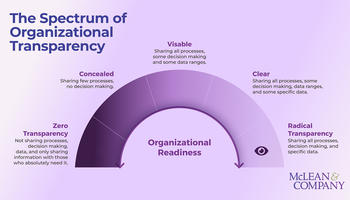
Use this resource to review the benefits and risks of transparency, the levels of McLean’s transparency spectrum, organizational readiness criteria for improving transparency, and details on both pay transparency and transparency regarding restructuring.
Transparency is here to stay. What level of transparency is best suited for your organization?
Refer to these case studies for examples of how organizations have developed transparency at different levels, in various organizations with different cultures a... Refer to these case studies for examples of how different organizations have developed transparency.These case studies will give you examples of:Adopting varying levels of.
Case Studies: The Rise of Organizational Transparency
Case Study: Culture
Refer to these case studies for examples of how organizations have developed transparency at different levels, in various organizations with different cultures and needs.
Filter by Content Type
Clear Filters (94)Featured Content

Employee Engagement Trends Report 2026
Insight, analysis, and benchmarking data for McLean & Company’s Employee Engagement ...