
Rid the Organization of an Inconsistent Culture to Improve Employee Engagement
Don’t let a confusing culture leave your employees in disarray.
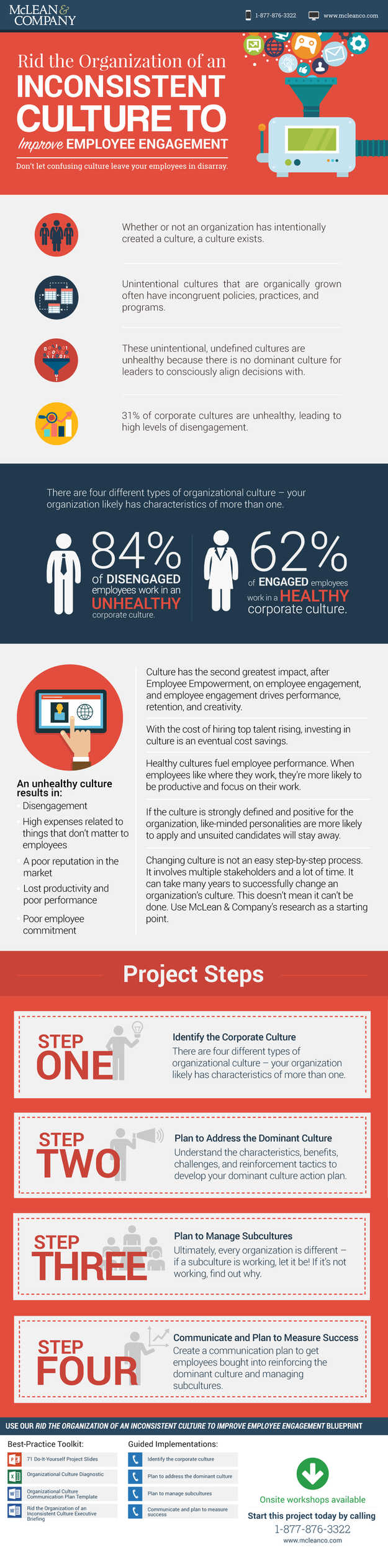
- Whether or not leaders at your organization have intentionally created a culture, one exists. Those unintentional cultures that are organically grown often have inconsistent policies, practices, and behaviors.
- There is no dominant culture for leaders to consciously align decisions with because the culture is undefined or unintentional.
- The result of these unintentional cultures is that 31% of corporate cultures are unhealthy. Given that culture is one of the top drivers of employee engagement, employee happiness and commitment suffer.
Need Extra Help?
Speak With An Analyst.
- Get on-demand project support
- Get advice, coaching, and insight at key project milestones
- Go through a Guided Implementation to help you get through your project
Our Advice
Critical Insight
- Culture is one of the top drivers of employee engagement, and employee engagement drives key business metrics.
- Beyond engagement, a healthy corporate culture brings many benefits, including attracting and retaining the right people, maintaining high levels of productivity, and increased retention.
- Only 31% of employees surveyed rated their organization’s corporate culture as healthy.
- There are four dominant culture types: Competitive, Innovative, Cooperative, and Traditional. Changing a corporate culture can be a great endeavor. Identifying your organization’s dominant culture type to better align company policies, practices, and programs is a good place to start.
Impact and Result
- Diagnose your organization’s culture to better understand the challenges of each culture and how to minimize them.
- Reinforce your organization’s dominant culture by using the right engagement drivers and implementing effective initiatives.
- Identify existing subcultures to ensure they are helping, and not harming, your organization’s dominant culture.
Workshop: Rid the Organization of an Inconsistent Culture to Improve Employee Engagement
Workshops offer an easy way to accelerate your project. If you are unable to do the project yourself, and a Guided Implementation isn't enough, we offer low-cost delivery of our project workshops. We take you through every phase of your project and ensure that you have a roadmap in place to complete your project successfully.
Module 1: Identify the Dominant Corporate Culture
The Purpose
- Understand the project rationale for why consistent culture is important.
- Identify dominant culture and determine how widespread other cultures are in the organization.
Key Benefits Achieved
- Clearly identified rationale to get stakeholders on board for the project.
- Defined next steps for how to address dominant culture.
Activities
Outputs
Discuss where you believe the organization lies on the matrix and why.
- Examples of how the organization is representative of each of the four types of cultures.
Discuss results from the Organizational Culture Diagnostic and identify next steps.
- Recommendation on which culture is the dominant culture, and understanding of how the other culture types are represented in the organization.
Module 2: Plan to Address Dominant Culture and Manage Subcultures
The Purpose
- Plan how to implement or reinforce dominant culture.
- Plan how to identify and manage subcultures in the organization where necessary.
Key Benefits Achieved
- Created action plan for how to reinforce dominant culture.
- Determined management guidelines for dealing with subcultures in the organization.
Activities
Outputs
Create the plan of action to reinforce a traditional culture.
- Identified goals, metrics, initiatives, responsibilities, and timelines to reinforce or implement dominant culture.
Create the plan to manage subcultures across the organization.
- Plan of action to address challenges, initiatives, responsibilities, and timelines for departments or locations where subculture is not working.
Module 3: Communicate and Plan to Measure Success
The Purpose
- Plan how to share the culture messaging to employees.
- Identify how to follow up and measure success of implemented plan.
Key Benefits Achieved
- Developed messaging to employees.
- Set and planned measurement for progress.
Activities
Outputs
Develop the employee communication plan.
- Communication plan that covers who is delivering and receiving the messaging, what the messaging is, where it is being shared, and when it is being shared.
About McLean & Company
McLean & Company is an HR research and advisory firm providing practical solutions to human resources challenges via executable research, tools, diagnostics, and advisory services that have a clear and measurable impact on your business.
What Is a Blueprint?
A blueprint is designed to be a roadmap, containing a methodology and the tools and templates you need to solve your HR problems.
Each blueprint can be accompanied by a Guided Implementation that provides you access to our world-class analysts to help you get through the project.
Contributors
- In-depth interviews with HR professionals, subject-matter experts, employees, and managers to gain a better understanding of identifying and reinforcing dominant cultures and dealing with subcultures.
- A series of engagement surveys to understand the impact culture has on employee engagement and other drivers of engagement such as manager relationships, employee empowerment, company potential, and senior management relationships.
- A survey with over 130 respondents directed at executives and HR professionals to better understand the challenges organizations face when it comes to reinforcing and intentionally creating each of the four culture types.
 Design the Employee Experience
 Shape the Frontline Employee Experience
 The Future of Workplace Collaboration
 Develop a Targeted Flexible Work Program
 Making Sense of Generations in the Workplace
 Return-to-Office Playbook
 Catalyze Cross-Functional Collaboration
 Sustain Work-From-Home
 Optimize People Leadership in the Hybrid Work Environment
 Train Leaders to Practice Foundational Communication Skills
