This insight is part of McLean & Company’s research on enabling AI strategy and scaling AI in HR operations.
Key takeaway: AI in HR operations succeeds when HR aligns people, process, technology, data, and governance to scale adoption into business impact. Deploying more AI tools alone will not deliver results.
In this article:
- What’s driving the gap between AI adoption and business impact.
- The five foundations required to scale AI in HR operations.
- How HR leaders can turn AI adoption into measurable impact.
Why does AI adoption in HR fail to deliver business results?
AI adoption in HR fails to deliver business impact due to poor data quality, weak governance, and lack of accountability.
Organizations are adopting AI across HR, but business impact remains limited. The issue is not adoption itself. HR was supposed to be one of the biggest beneficiaries of AI. Automated scheduling. Smarter recruiting. Faster onboarding. Predictive retention. So why does it still feel like HR operations are running on spreadsheets and workarounds with an AI chatbot bolted on the side?
The promise of AI in HR is real, yet results remain elusive with only 7% of organizations achieving full AI transformation.
According to McLean & Company’s AI strategy research, most organizations have widespread AI adoption but moderate impact. Pilots launch, expected value falters, and HR – already constrained by regulatory complexity, poor data quality, and lack of integration – struggles to move forward.
Why is scaling AI adoption in HR difficult?
Gaps in data, governance, and HR workflows are preventing organizations from moving beyond pilots and scaling AI adoption in HR operations.
The frustration with AI in HR operations is not a technology problem; it is a broader challenge that spans multiple dimensions. McLean’s framework is clear: Value is realized only when people, process, technology, data, and governance evolve together. In most HR functions, this is not yet happening.
HR data is among the most complex in any organization, layered with privacy obligations, compliance requirements, system integrations, and quality gaps. AI cannot deliver reliable outcomes on a shaky data foundation, no matter how sophisticated the model.
At the same time, AI is moving fast. Agentic AI systems do not just surface insights, now they act: scheduling interviews, drafting offer letters, analyzing employee sentiment. That changes job design, decision rights, and accountability in HR in ways most teams have not mapped yet.
Meanwhile, the governance frameworks HR helped build to manage AI risk are already lagging. Responsible use of AI in people decisions requires more than policy. It requires embedded oversight, transparency, and genuine human accountability at every step.
AI in HR operations is stalling, not because the technology is unavailable. It is stalling because the conditions for success are not yet in place. That is where HR must lead.
Why treat AI as an HR transformation?
Organizations scale AI in HR faster by treating it as an operating model transformation, fundamentally rethinking how HR operates to close the adoption-to-impact gap beyond simply deploying AI tools.
AI will not transform HR operations on its own. And deploying more tools without fixing the foundations will not close the gap. The organizations seeing tangible results are not the ones with the most AI, they are the ones that treated AI adoption as an organizational change initiative, not a technology one.
For HR that means owning the AI transformation rather than just enabling it. HR must make clear decisions about where to deploy AI, where to maintain human oversight, and where to draw the line. It means clearly defining constraints on enablement and advancing AI maturity.
HR requires intentional strategies and capacity to effectively support AI enablement and scaling to build the trust, capability, and culture that AI-enabled operations mandate.
The five foundations of AI-enabled HR operations
Successful AI in HR depends on five interconnected foundations: people, process, technology, data, and governance.
McLean’s framework points to five interconnected dimensions of successful AI adoption in HR: people, process, technology, data, and governance. These foundations must evolve together to enable scalable, responsible AI adoption. None of them work in isolation.
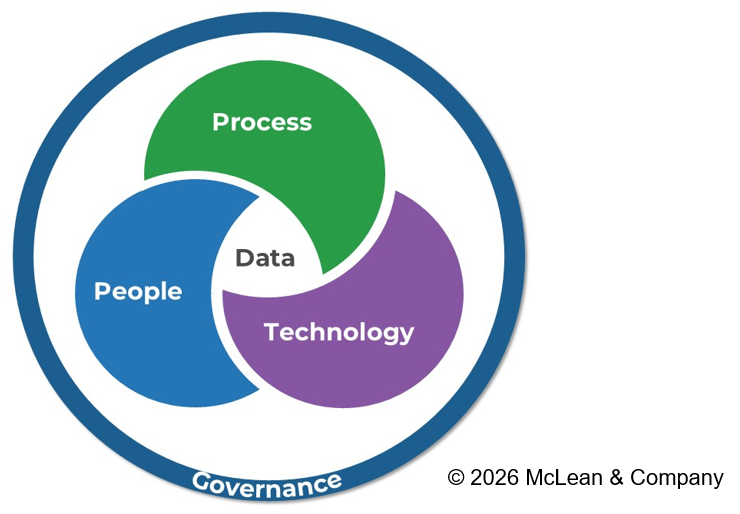
People: Invest in the human side of AI adoption in HR.
Strong change management, targeted reskilling, and a culture that supports innovation and psychological safety are critical to scaling AI in HR operations.
Processes: Redesign HR workflows with AI and automation in mind.
Look for opportunities to reengineer HR workflows to include AI-enabled capabilities, not simply automate existing steps. Be clear about the outcomes and business value AI should deliver across HR operations.
Technology: Evaluate the full range of AI tools and platforms supporting HR operations.
Core HR systems, AI assistants such as Microsoft 365 Copilot and Google Gemini, and AI-enabled HR platforms all have a role. As agentic AI shifts from supporting HR work to executing it, a clear HR AI technology strategy becomes essential.
Data: Strengthen the HR data foundation before scaling AI.
High-quality HR data, strong privacy controls, and integrated systems are essential for reliable AI outcomes. Without well-governed and integrated data, AI in HR operations will struggle to deliver consistent results.
Governance: Move beyond policy and embed AI governance into HR workflows and decision-making.
Responsible AI in HR requires clear human oversight, transparent decision processes, and defined accountability for outcomes, especially in employee-facing use cases.
Explore McLean & Company’s resources to enable AI in HR operations
The organizations turning AI adoption into measurable impact treat transformation as one connected program. Sustaining the work long enough to see compound returns can be difficult. Below is a curated set of McLean & Company resources to support AI-driven transformation: